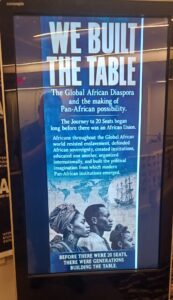
AU ECOSOCC Engagement with the Diaspora: “The Journey to 20 Seats”
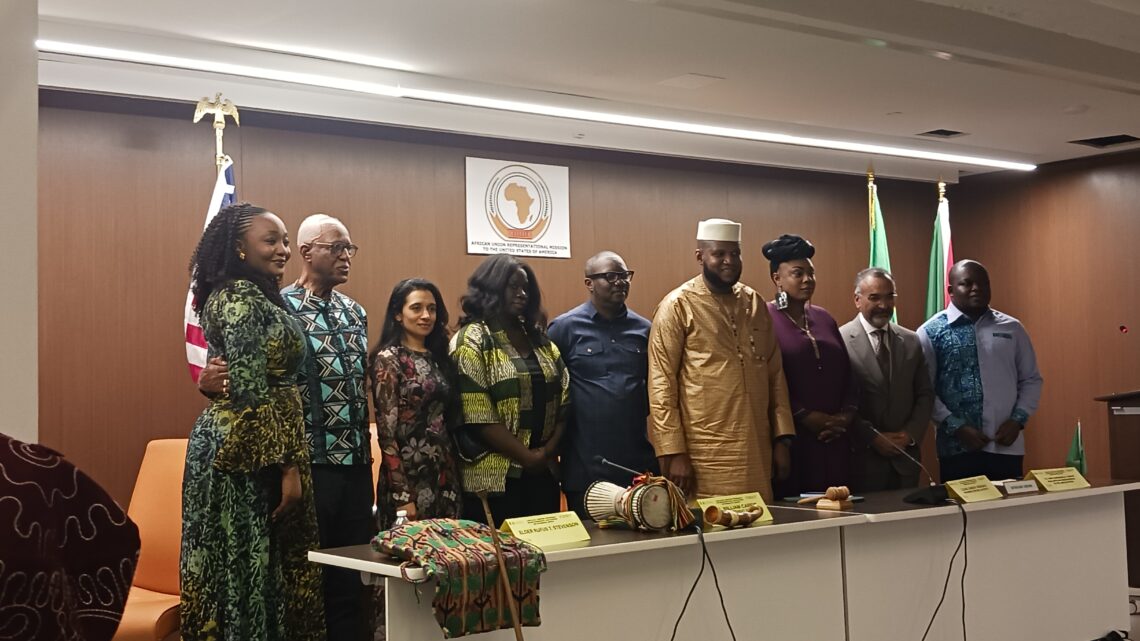
 The Sixth Region Diaspora Caucus (SRDC) was honored to be able to attend a “high level engagement” between the African Union’s Economic, Social and Cultural Council (AU ECOSOCC) and members of the Pan Afrikan Diaspora at the African Union Mission, which is often known as “Africa House”, in the Georgetown area of Northwest Washington, DC, on Friday, September 18, 2026. Among the conveners of this session was the Teaching Artist Institute (TAI), founded and led by Baltimore area activist and teaching artist Sis. Kim Poole. Among the Baltimore area Pan Afrikan activists in attendance were Bro. Cliff Kuumba (SRDC), Sis. Tomiko Shine (APPHRC/Solitude Think Tank), Baba Ishaka-Ra-Hannibal-El (Maryland Council of Elders) and Sis. Kim Poole (TAI).
The session started with a panel that introduced the audience to the developing relationship between the AU ECOSOCC and the Pan Afrikan Diaspora.
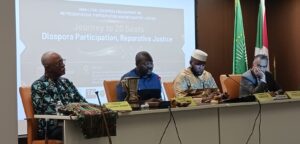 Baba Rufus Tiefing Stevenson, Cultural Evangelist, spoke about his personal experience, how he met Sis. Kim Poole and became involved with her Teaching Artist Institute (TAI), and his work with Continental activists to help bring us all to this point.
Ambassador William Carew, Head of the ECOSOCC Secretariat, recognized that there are Afrikan Diasporans, especially US-based activists, who have thought the AU does not follow through on promises. He assured the audience that the AU has not been standing still, and cited several AU decisions from establishing frameworks to recognition of progress made, earned through persistence and patience, and now that now has come to reality. He personally recognized SRDC (Bro. Cliff Kuumba), Aging People in Prison Human Rights Campaign/Solitude Think Tank (Sis. Tomiko Shine), Teaching Artist Institute (Sis. Kim Poole), TrustAfrica and other organizations.
Mr. Louis Chiek Sissoko, Presiding Officer of ECOSOCC noted that the Diaspora has long been part of Afrika’s liberation, economic and cultural development. What was missing, he said, was an institutional framework to facilitate the Diaspora’s participation in ECOSOCC. He stressed that an Afrikan community does not end at Afrika’s shores, and he looks forward to more conversations and partnerships with the Diaspora.
Mr. Tarek Ben Youssef, Deputy Chief of Mission, Africa House/AU Mission, welcomed everyone to Africa House, “a house that belongs to every Afrikan.” He informed the audience that now ECOSOCC is preparing for the election of the first cohort of delegates from civil society. Diaspora delegates will participate with the same standards and same accountability as those from the AU member states. ECOSOCC is the voice of the Afrikan citizenry, and as such the General Assembly without the voice of the Diaspora is incomplete. Securing the 20 seats for the Diaspora is the beginning, not the end. The real work lies ahead. Confronting the legacies of the slave trade, apartheid and reparations are part of the same agenda of recognizing and restoring the dignity of Afrika. He stressed that the doors of the AU Mission are open to the Afrikan Diaspora in the US; it “exists to serve the African Union relationship with this hemisphere, and that relationship is incomplete without you. We want to be your bridge to the African Union, through this institution, its programs and its opportunities. If you are a Diaspora organization seeking to engage with the African Union, come to us. … The Mission will be your entry point, your partner and your ally in ensuring that the Sixth Region is not just represented in name but in practice. … What we begin today in Washington, DC must carry forward to the United Nations General Assembly, to the African Union Summit, and to every platform where the voice of the Diaspora must be present. The seeds have been planted; today, as the theme of this engagement reminds us, we must let them grow.”
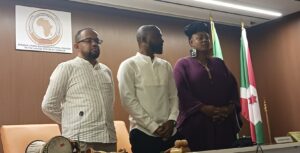 Baba Kyeretwie Akwasi Osei, Head of Programmes, spoke about the legal structure and provided some details about the plan to include the Diaspora in ECOSOCC. Within the AU, the Diaspora is “an integral part of who we consider Afrikan; we don’t make a distinction.” The Constitutive Document is clear, he said, that the Diaspora is an integral part of the Union. ECOSOCC needed to be “composed entirely by citizens … to serve as a bridge between the African Union and its citizens.” Naturally that includes those in the Diaspora, he stressed; from day one that has been understood. The General Assembly consists of 150 seats, a parliament for civil society for Civil Society Organizations (CSOs) and civil society in general to come together. 20 seats of those 150 are reserved specifically for the Afrikan Diaspora. Why has it taken this long to reach this point? The Diaspora is not monolithic, and the challenge for ECOSOCC was how to translate the political will to something that will allow the AU to bring representative delegates to those 20 Diaspora seats. ECOSOCC had established Statutes shortly after the announcement of the African Union Initiative in 2003, but since that time those Statutes have been revised to the plan they have now. They started with a regional approach that includes 3 zones: Europe, the Americas/Caribbean, and Asia/Middle East/Oceania. After a number of “flagship” engagements with the Diaspora and constant engagement with components of the Diaspora, the AU institutional framework was developed 4 years ago with as wide of a consultation as he could recall for any process. He stated that the parameters on how to reach the 20 seats and the apportionment of those 20 seats between the Americas, Europe, etc., had not been established (even though SRDC had devised parameters and a plan to make those seats a reality back in 2008, before the current ECOSOCC leadership took over). After a period of consultation, a webinar series and input from Diaspora members and consultants, the next big part was to get the resultant plan endorsed by the AU member states. It took three years to get the endorsement they needed with amendments required. Last February the plan they had devised was officially adopted by the AU Assembly and is “the law of the land” to get the 20 delegates from the Diaspora seated in the General Assembly. “Now we need to make it happen. … We have the policy that we need to put into practice.” He was coming back to seek our input on how to make this work in the most seamless way possible, translating the political will for the Diaspora into practice. For example, with the campaign for reparations, there is the need for an overall climate and environment to provide as many spaces for the Diaspora to express itself as possible. The United Nations General Assembly (UNGA) resolution on slavery as a crime against humanity established an institutional premise for the fight for reparations and to strengthen bonds with the Diaspora. Now, what are the mechanics needed to get us there?
The AU ECOSOCC Legal Counsel offered some operational details and regulations for engagement. The ECOSOCC Statutes from 20 years ago made the mandate clear. The AU must organize the Diaspora to 20 seats, but needs a legal framework to govern the participation of the Diaspora in the ECOSOC General Assembly, “the highest decision-making body of ECOSOCC, and AU in general.” The establishment of representatives to the 20 seats is the start of the process, not the end; the obligations begin there. The allocation of 20 seats will be as follows:
Americas, North, Central, South and Caribbean = 10 seats
Europe = 5 seats
Asia = 2 seats
Oceania = 2 seats
Others = 1 seat
A mechanism for the allocation of specific seats in the Americas is bring researched.
The manner of representation is based on the fact that ECOSOCC is considered a grassroots organization. That being said,
- Individuals cannot apply, a representative must belong to and represent an organization in the Diaspora
- This is not a lifetime mandate; a representative serves a term of four (4) years and is eligible for re-election
- ECOSOCC operates as a parliament of representatives to help improve the policymaking process at the AU level by sharing their voice and concern through 14 committees in which they must participate
Criteria that allow participation in ECOSOCC:
- Representatives must be from an African Diaspora Civil Society Organization (CSO)
- That CSO must be registered somewhere in the world
- There is a financial requirement. Some CSOs are small, some are massive, but all must have a financial statement and show good financial governance as well as a legitimate source of funding
- CSOs must show that at least 50% of members are from the Diaspora
- CSOs’ values must align with AU and Pan Afrikan values
- CSOs and their representatives must show some competency in at least one of the 14 committees
The course of application and election is planned as follows:
- Every 4 years, applications are received; about 100 CSOs have applied this year
- ECOSOCC evaluates the application against the criteria, and those who meet the criteria will stand for election after vetting by the Credentials Committee
- Those who pass vetting go through an election process; for example, if 30 CSOs pass muster in the Americas, they will go to election for the 10 seats
- Those CSOs that pass muster and are qualified will enter into an Electoral College and cast 10 votes, one for themselves and 9 others
- The election is conducted virtually until the 10 CSOs are determined, with 16 votes as a threshold for establishing a majority that constitutes election victory
- Several rounds may be needed to reach 10 CSOs with the required number of votes for election
There are also rules and regulations as to what an ECOSOCC CSO is allowed to do to promote or support itself. An ECOSOCC CSO cannot use ECOSOCC for promotion and resource collection without permission. CSOs have been expelled from the General Assembly when they have violated this regulation.
By end of November, the plan is to have elected the 20 CSOs for the ECOSOCC General Assembly and formally appoint them.
Baba Kyeretwie Akwasi Osei added that these requirements apply to all 150 ECOSOCC CSOs, from the Continent as well as the Diaspora.
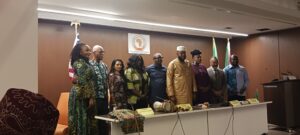 Sis. Kim Poole, Teaching Artist Institute, added that “ECOSOCC has been a transforming institution before our very eyes” … This is “an opportunity for us to be part of this process in real time.” She also stressed that, while TAI has been involved in the organization and conduct of this “special high level engagement”, she herself will not be able to assume a seat as a representative in ECOSOCC despite being a member of the Afrikan Diaspora and the founder of a CSO. She explained that TAI is currently stronger in Afrika than in the Diaspora so they cannot currently assume a seat in the ECOSOCC General Assembly; however, TAI and its members are consulting and working to act as a conduit to help other orgs, “to bring folks like SRDC into the room.” Baba Osei noted that important role when he pointed out that much of the work will be done outside of the General Assembly; CSOs that are not in the General Assembly will have opportunities to participate in consultative work with AU ECOSOCC. There are a number of “clusters” for those who are not among the 150 delegates in the General Assembly. Thus, just because one misses the General Assembly now, does not mean there is no role for them in the AU ECOSOCC.
 Closing Remarks
Bro. Cliff Kuumba, Maryland Facilitator of the Sixth Region Diaspora Caucus (SRDC), speaking on behalf of the organization in place of its Director, Professor David Horne, made a statement on SRDC’s continuing work to establish a grassroots-representative election process for the Diaspora to ECOSOCC:
I am Bro. Cliff, Maryland Facilitator of the Sixth Region Diaspora Caucus and a member of SRDC’s Secretariat.
SRDC was founded in 2006 by a Coalition of Pan Afrikan activists to answer the original ECOSOCC Statutes to organize the Pan Afrikan Diaspora and bring our voice to a new, people-centered African Union and to assist in the “development of the Continent and the building of the African Union”. The Diaspora was defined as “peoples of African descent and heritage, living outside the African Continent, irrespective of their country of citizenship, who are willing to assist in the development of the African Continent and the building of the African Union.”
Starting in January 2007 and continuing in fits and starts to this day, SRDC has pursued the mission of establishing representatives to ECOSOCC. The original ECOSOCC Statutes called on us to develop a method for electing representatives, and that’s what we did. That proposed method was to be reviewed by African Union officials, and in that process, a new plan was finally developed by ECOSOCC itself. Thus, there have been many detours, some confusion and a few roadblocks along the way, and the resolve of some of the Diaspora’s activists, especially us in SRDC who have fought for this for 20 years, has been challenged as a result, with some of us passing on to the Ancestors and others succumbing to fatigue, but SRDC continues to work regardless, and press for this goal, working to persuade our fellow Diasporan activists that the AU’s vision and our part in it are worth pursuing, and to seek collaboration with AU ECOSOCC toward a process to establish representatives in ECOSOCC that can be elected by the people of the Diaspora.
Being in a civil society organization, or a CSO, is important, and a source of funding is important, but there are organizations that may act as gatekeepers to ensure their own representation at the expense of the “people on the ground”, and as for source of funding, SRDC, for example, has been largely funded not by corporate donors, foundations and governments who could exert undue influence, but by our own personal bank accounts. I can think of no more important criterion for accreditation than that. And the representatives would be nominated and elected by the people in the grassroots communities at the local level, ensuring that any representative to ECOSOCC was elected by their own people, citizens of grassroots Diaspora civil society. The current plan certainly differs in some important ways from the original plan, for example Who Will Be Casting the Votes for Those who are Supposed to Speak for Them, but we remain hopeful that what finally results will be acceptable to the African Union, to ECOSOCC and to the organizers and activists of the Diaspora.
We realize that there is much work still to be done to ensure that those who sit in those 20 Diaspora seats were chosen by the “people on the ground” in the Diaspora, not just from the US as some of us seem to believe, but also from South America, Central America, the Caribbean, Europe, Asia and Oceania. Hopefully, the discussion today casts some light on the process that can reinvigorate Diaspora organizers and activists to move toward that people-centered Continent and Diaspora, working together to move the Pan Afrikan world forward toward true self determination, unity, liberation, representation on the world stage, prosperity and uplift for Afrika, her Scattered Black Children, and the world in which we all live.
SRDC remains ready to engage with Africa House to move this process forward. I live just outside Baltimore, Maryland, Sis. Kim Poole lives in Baltimore, Maryland as do Baba Hannibal and Baba King, and we can arrange to meet here with leaders as we continue to reach out to our grassroots Diaspora.
 SRDC will hold our International Conference at the University of Ghana in Accra from October 6-9, and if a direct invitation to African Union and ECOSOCC officials has not been received, let me make that invitation in person now, to be followed up with formal invitations to AU officials in the coming week.
SRDC looks forward to continuing the effort to build this representative process for the Diaspora in the ECOSOCC and to bring our voice to the world stage as Ancestor Malcom X told us to do 62 years ago when he told us to stop taking our case from the wolf to the fox, to take Uncle Sam before the world and into the World Court so that she [America] may be judged according to her true deeds.
Again, I want to thank you all for this opportunity to join with you to listen and to speak a little bit, thanks again. Peace and power.
Dr. Anika Altaf, Executive Director of INCLUDE Platform, made an Invitation to the Diaspora to engage in economic development and Diaspora investments. According to Dr. Altaf, annually around $100 Billion are sent back to Afrika in remittances; thus there is a strong willingness from the Diaspora, both Afrikan Descendants (“Historic Diaspora”) and Continental Africans (“Modern Diaspora”) to invest in the Continent. Much of that money and resources does not actually go to the development of the Continent; we must build on the political participation and also participate economically and through what she referred to as “coming home to invest: the Africa-Diaspora Investment Corridor.” The following week, she and her colleagues would go to UNGA (United Nations General Assembly) for a meeting chaired by the former Vice President of Nigeria, and she invited the Diaspora to participate with them. She was aware of the Pan African Global Trade and Investment Conference (PAGTIC) being held in late October in Ghana, and Bro. Cliff also made note of the October 6-9 SRDC International Conference at the University of Ghana in Accra and invited her to attend and interact with SRDC leadership there.
Baba Tarek Ben Youssef made Closing remarks and brought the session to a close. Attendees then briefly socialized over light food and were interviewed by Sis. Tomiko Shine (Aging People in Prison Human Rights Campaign and Solitude Think Tank) for a brief documentary being produced about the gathering and the AU-Diaspora connections being made.
Overall Impressions
 As for this writer, my overall impression of this gathering is that it represented a beginning, and that this beginning holds great potential for progress. While the leadership of AU ECOSOCC seems to have developed a system through which Diaspora representation may finally bring our voice to the African Union and thus the World Stage, the current selection process seems less robust, and thus less likely to bring the voice of true grassroots activists (especially those who might be critical of current AU practices) to the international arena than the one SRDC had developed in 2008 according to mandates documented in the original ECOSOCC Statutes, a process which the AU ECOSOCC had promised a Technical Committee review that apparently never occurred and was ultimately rejected in favor of the current plan. Indeed, as AU ECOSOCC officials stated during the session, there are a number of activists in the grassroots Pan Afrikan Diaspora, particularly the more informed revolutionary Pan Afrikanists, who have lost a degree of trust in the AU, criticizing it as a group of bureaucrats that is too heavily influenced by the European Union, the United States and global corporate interests to truly understand, work with and fight for the Diaspora that wishes to see not only a united Pan Afrikan World but also reparations and repatriation for the Diaspora. As I stated in my closing remarks, SRDC has endured several setbacks, some of which can be traced to AU ECOSOCC bureaucracy and some of which were exacerbated by the “crabs in a barrel” behavior by some of our own activists and organizations, and there is some concern that the current process being touted by ECOSOCC may present an “official” opportunity for some Diaspora CSOs that have already set themselves up as gatekeepers to consolidate their hold on the minimal power that they have been able to amass as self-described Diaspora spokespeople and “leaders”. But, despite these concerns, this meeting established the intent of AU ECOSOCC to build a pathway, however twisted and fraught with rocks, crevices and other potential difficulties, for the Diaspora to finally establish a voice in the AU and begin to finally follow Honored Ancestor Malcolm X’s assignment to “stop taking our case from the wolf to the fox” and “bring Uncle Sam before the world” that he gave us 62 years ago. It is our hope that integrity and sincerity will rule the day, and the African Union and the Pan Afrikan Diaspora will be able to put into motion the process by which we will be able to lift up the Pan Afrikan World at last.